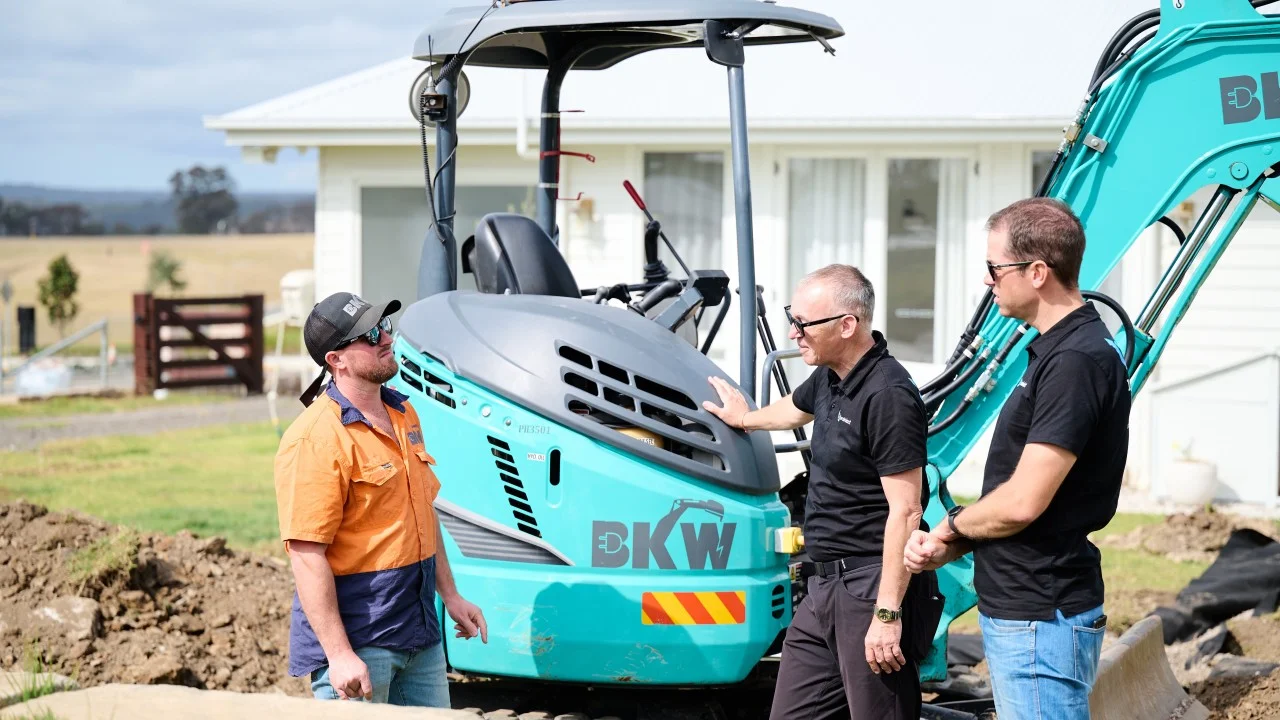
One of my plumbing clients loves operating the excavator.
And I mean genuinely loves it.
Put him on the machine, give him a clear job and he is happy.
He is good at it.
He gets an immediate result.
At the end of the day, he can look behind him and see exactly what has been achieved.
There is nothing inherently wrong with that.
Business owners are allowed to enjoy the work.
They are allowed to jump on the tools occasionally.
They are allowed to help the team when it is genuinely required.
The problem is not the excavator.
The problem is what may not be happening while he is sitting on it.
While he is operating the machine, who is developing the operations manager?
Who is reviewing the numbers?
Who is improving lead generation?
Who is fixing the quoting process?
Who is following up key opportunities?
Who is dealing with poor performance?
Who is building the systems and leadership required for the business to operate without him?
Because the excavator may be producing visible progress while the business itself is standing still.
This is a common trap.
Business owners often remain stuck in technical work not because they cannot delegate it, but because they enjoy it.
It is familiar.
They know they are good at it.
It makes them feel useful.
It gives them control.
And, unlike leadership, it produces a result they can immediately see.
At the end of a day on the tools, you can point at something and say, "I did that."
At the end of a day spent recruiting, coaching, planning, reviewing margins or building systems, you may not have anything physical to show for it.
No trench.
No installation.
No completed product.
Just a collection of conversations, decisions and notes that may take months to produce an obvious result.
That is why so many owners undervalue leadership work and overvalue physical activity.
They feel productive because they are busy.
But busy is not the same as valuable.
Owners usually have a collection of reasonable-sounding explanations for staying involved.
"Nobody can do it as well as I can."
"It is quicker if I do it myself."
"I enjoy being on the tools."
"The team needs me."
"I am saving the business money."
"I only need to help for a couple of hours."
"I do not want the employees thinking I am above the work."
Some of those statements may be partly true.
But they can also become extremely convenient stories.
Stories that allow the owner to stay where they feel most competent instead of moving into the role the business actually needs.
Here is the central point:
Skill can usually be bought or taught.
Someone else can be trained to operate the excavator.
Someone else can install the product.
Someone else can complete the service.
Someone else can follow the checklist, manage the schedule, liaise with the customer or run the crew.
They may not do it exactly the way you do it.
At first, they may not do it as quickly.
They may need training, feedback and the occasional firm conversation.
But the skill itself is generally replaceable.
The owner's unique value increasingly sits somewhere else.
Direction.
Standards.
Culture.
Commercial judgement.
Recruitment.
Capital allocation.
Leadership.
Relationships.
Strategy.
Accountability.
Creating opportunities.
Making the decisions nobody else can make.
Building the machine.
The larger the business becomes, the more expensive it is for the owner to spend time doing work somebody else can perform.
This is where the "I am saving money" argument falls apart.
An owner may think:
"Hiring another operator will cost me $50, $70 or $100 an hour. I may as well do it myself."
But that calculation ignores the opportunity cost.
While you are saving $70 an hour, you may be neglecting a sales opportunity worth $50,000.
You may be postponing a recruitment decision that would unlock the next stage of growth.
You may be avoiding a difficult conversation that is costing the business thousands every month.
You may be failing to build a system that could save hundreds of hours over the next few years.
The value of your time is not simply the wage you save by doing lower-level work.
It should be judged against the highest-value activity you could be performing.
There is also an identity problem underneath all of this.
Many business owners began as technicians.
They were the best tradesperson.
The hardest worker.
The person who solved the problem.
The one everybody called.
The one who knew how to get the job done when nobody else could.
That identity helped build the business.
But replacing yourself can feel like losing it.
You may quietly wonder:
What am I useful for if I am not doing the work?
Will the team still respect me?
What will I do all day?
What happens if someone becomes better at this than I am?
What happens if the business no longer needs me?
The goal is not to become unnecessary in the sense that you have no value.
The goal is to become unnecessary to routine delivery so you can become more valuable at a higher level.
My client now has an employee moving into an operations management role.
That is a significant step.
But the role will only develop if the owner keeps delegating and allows that person to carry responsibility.
Every time the owner jumps back in too quickly, takes over or completes the task himself, he may believe he is helping.
But he may actually be teaching the team that responsibility always returns to him.
That is how you accidentally train dependent employees.
Delegation requires you to tolerate a period where someone performs the task differently.
Possibly more slowly.
Possibly with a few mistakes.
The standards still need to be clear.
Training still needs to be provided.
Mistakes still need to be reviewed.
But you cannot create leaders while constantly taking leadership back from them.
Enjoying a task does not mean it is the best use of your time.
Being good at something does not mean you should continue doing it forever.
The work that made the business successful in the beginning may now be the very work preventing it from reaching the next stage.
So ask yourself:
What work are you still doing because you enjoy it?
Which task makes you feel productive but prevents you from leading?
And what responsibility do you keep taking back from your team?
👉 This week, identify one task that somebody else could be trained to handle and let them handle it.
Set the standard.
Give them the training.
Allow them to do it differently.
Resist the urge to jump back in the moment it becomes uncomfortable.
You do not need to sell the excavator.
You may simply need to get off it a little more often.
If you'd like to know when a place becomes available in my one-on-one coaching program, join the waitlist below.
https://promotions.brainiact.com.au/one-on-one-coaching-waitlist
Coach Jared
Originally published in On Owning a Business on LinkedIn ↗.